Following illustrations show the correct/desirable conformation (a) and faulty one (b-e).
Fig. 1. Types of build and deviations in shoulder assembly.
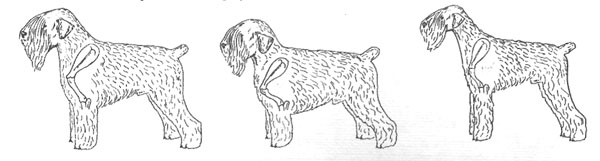
a. b. c.
a. Sturdy-rough, desirable type; correct shoulder assembly.
b. Rough (coarse) type, steep shoulder.
c. Sturdy-dry type, straight shoulder.
Fig. 2. Head.
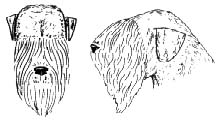 a. Correct head
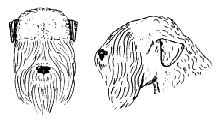 b. Short, coarse, cheeky, too wide in the skull.
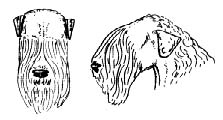 c. Narrow, light head.
 d. Rounded back skull, short muzzle; short light muzzle.
Fig.3. Ears.
 a. Correct size and set of ear.
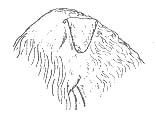 b. Too small, light, set too high.
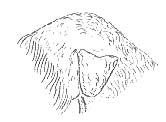 c. Too big, wrinkled, set too low.
Fig.4. Form of ribcage and front view.
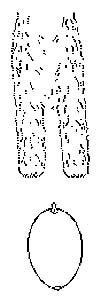
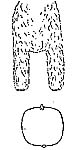
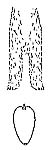
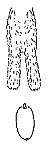
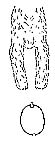
a b c d e
a. Deep chest of good volume and correct spring of ribs. Correct front legs.
b. Barrel chest, round ribs, overly wide front.
c. Slab-sided, deep chest but with flat ribs; narrow front, toeing-out.
d. Narrow chest, narrow front.
e. Shallow chest, elbows out (loose in movement).
Fig.5. Hindquarters.
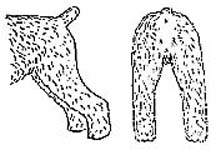 a. Correct hindquarters, correct tail set.
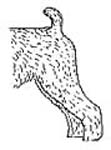 b. Straight croup, gay tail.
 c. Short upper thigh (femur), long second thigh, overly long slanting
rear pastern (sickle hocks).
c. Short upper thigh (femur), long second thigh, overly long slanting
rear pastern (sickle hocks).
 d. Short upper and lower thighs, long pastern, insufficient angulation
of stifle and hock joints.
d. Short upper and lower thighs, long pastern, insufficient angulation
of stifle and hock joints.
 e. Hocks too close, cow-hocked.